

There’s a parable of ambiguous origin set in ancient East Asia with which I was first acquainted in the wake of a severe panic attack years ago by my husband (then boyfriend) attempting to help me grasp and embrace my courage. It’s about a monk and a warlord.
The story tells that long ago a temple was sieged by a terrifying warlord, and all its inhabitants spare one monk fled for safety. Entering the temple, the warlord confronted the monk saying “Do you not know who I am? I am the man who could run a sword through you without flinching.” To which the monk replied, “Do you not know who I am? I am the man who could be run through by your sword without flinching.”
I was reminded of this recently by the death of a baby mouse.
In the past few months my primary formal occupation- an arduous detour through several other lifetimes it felt to have circled back around to- has resumed being that of a student. The older I’ve gotten I’ve come to realize that many, many of the most important lessons I often learn are taught outside of any classroom. In school, the lesson comes before the test. In life the test often comes before the lesson.
Pithy adages aside, as I was ascending the stairs bright and early on a Monday morning, I was stopped by a younger student who had confused me for some kind of faculty or staff at the college. These things happen. He was shy, and socially awkward. At first, I didn’t know he was even addressing me until he raised his voice with what turned out to be the goal of pointing out that there was a mouse on the stairs.
Every fiber in me sprang into action! I immediately knew I was on a timer to ferry this delicate animal to safety. It was a tiny, dark grey baby field mouse no larger than a half dollar, breathing almost imperceptibly and curled up tightly into a corner of a landing on the stairwell. I bolted up the flights of stairs another two levels to the classroom and quickly shed my belongings next to my usual desk, declaring my mission- and took off around the whole of the building desperately searching for something with which to scoop up the tiny creature. To no avail. End to end across multiple floors, I briskly swept the building- tried janitors’ closets, offices, empty classrooms. No such implement was to be found! The timer was running. And when I did finally in the cafeteria, approaching that stairwell, come across an empty plastic announcement paper display (the kind with the bend in its base to help it stand)- it was only just too late…
This was the second time this had happened to me, almost beat for beat. Years prior, during my time physically and financially recovering from a serious injury, I spent a while working as a mall cop. Patrolling the back corridors, behind the stores where I often found quiet, meditative contentment- I came across a first baby mouse in a similar condition. It had fallen from the rafters, or the pipework high above onto the concrete floor and was tangled in a mess of spider webbing. It didn’t move when I approached it and was gently gasping for air with its face in the vice of a permanent grimace. Everything in me wanted to get it to safety, knowing it wasn’t long for the world- to find it a shaded patch of soft grass where it could go peacefully in the comfort of the wind and the sun.
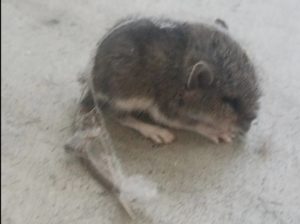
I sent the director, the head honcho in charge of operations at that job, a picture on my phone of the critter. And radioed to ask if I could be given something to scoop it up and carry it. I didn’t want anyone coming by, encountering it, and visiting it with further indignity.
His response had been to dispatch the second in command to scoop it up in a dustpan. He came to console and reassure me it was handled. Shortly after I learned it had been tossed in the dumpster outside the food court. It haunts me still from time to time, my failure to protect and give it a dignified, peaceful death. And the mouse at the school was my chance to make things right…
I returned to the stairs where I was met by the young woman from the student government office whose curiosity I’d spun up with one of my exasperated inquiries, and who’d gone to the stairs to see what all of the fuss was about. She told me I was a moment too late. A janitor had come by and stepped on the mouse, snatched it up in a paper towel, and thrown it away like trash.
Everything within me in that moment wanted to burst. I replied blankly with a reflexive, military stoicism “understood” before continuing my way through the tiny, gathered crowd on the stairs to the classroom to gather my things. I’d been early to school, as usual- but no longer had it in me to attend that class. I told the professor despite his courteous protestations that I should leave my things that I needed a minute and left. I walked quickly but quietly to my car outside in the parking lot, where I called my husband and proceeded to bawl my eyes out, choking through the explanation of what had just transpired. It was an anecdote with which he was already intimately familiar, and he joined me in what became our mourning.
The mouse on the stairs may have been dying or abandoned for some illness or injury. It may’ve simply been lost. But it wasn’t garbage. And it posed nobody any real harm.
Around the house, we have an aversion to needless hostility toward insects and animals as a domestic virtue. Spiders are comrades, and we overwhelmingly endeavor to maintain a policy of catch and release for other visitors. Such is nature. Predatory vespids that harass our farm cat friend, Butterscotch Kitty, while she tries to eat the food we leave out for her may be the outstanding exception.
Anyway, after some modest time spent gathering myself in the quiet warmth of the morning light inside my car I rallied to attend my final class for the day. The duration of the class was spent distracted by meditations on the circumstances leading to the abrupt and violent death of the baby mouse. An event so minute, and so terribly common as to be deemed trivial.
It was then I was reminded of the fearless monk and the terrifying warlord. It dawned on me over the inconsequential hum of calculus instruction that there has always been a greater wisdom to that allegory than I’d previously appreciated. Its implications and applications reach beyond definitions of courage and into the philosophies we adopt and inhabit regarding our conduct as we travel through our existences in this world.
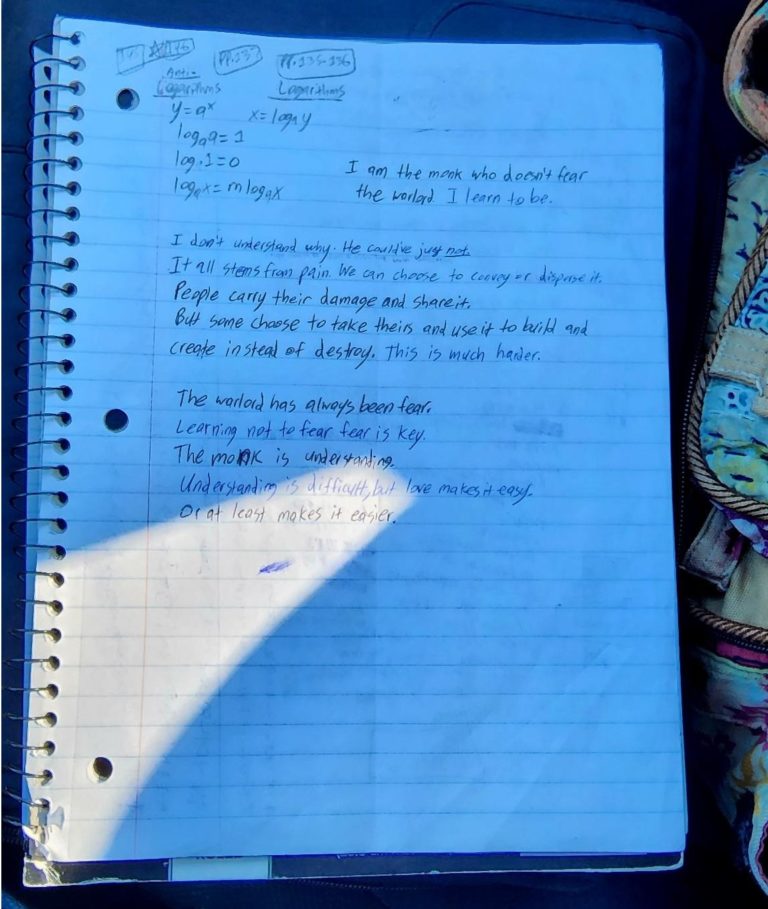
Many cultures have historically distilled the eternal conflict at the heart of existence into two broad categories. These usually bear some variation of the token monikers “good” and “evil”. From the depth and scope of my experience, I’ve come to understand it more as a push-and-pull, a sort of tug of war (albeit far less two-dimensional) along the metaphysical parameters of love and fear. Or wisdom and ignorance.
Perhaps the janitor who served as the mouse’s executioner reacted reflexively to the set of material conditions that would lead him to perform such an action. Perhaps he (even subconsciously) saw the swift decisiveness of his choices to be a reflection of helpful strength. He was simply being a janitor.
As the professor from the missed class of that morning would go on to articulate in response to my apologies- the mouse, too was just being a mouse. It couldn’t help being what it was. It had less of a say in its existence than the janitor had agency over his course of action. What both of them had in common were elements of fear, and what ultimately determined the mouse’s fate was power.
The monk and the warlord in the story represent oppositional relationships to power. Appearances to the contrary, the power the monk possesses over the warlord is that of understanding. The monk understands the warlord, whereas the warlord greets the monk with confusion. It’s what places the monk beyond the reach of such trivial challenges as threats and swords.
In the course of the following week, while idly browsing for something to accompany breakfast before leaving for school another day, I was met with a subtle but quintessential distillation of these principles at play in the form of courtroom testimonies from the recent conclusion of the trial of the Stoneman Douglas High School shooter.
The first testimony I watched was that of a young woman named Victoria Gonzalez. She had been the girlfriend of a fellow student who was killed during the shooting- a young man named Joaquin Oliver. She delivered her powerful testimony wearing the shirt Joaquin had worn the night before he was murdered. What struck me in the raw wisdom she spilled that day in the courtoom were the ways in which her words were seasoned, despite the fact that she was most directly addressing her lover’s killer, with empathy and insight. With pity and regret. She sincerely and artfully recalled and contrasted heartfelt portraits of the lone, strange student turned gunman and the man she loved whose life would be so tragically cut short by his actions. There was an air of unshakeable grace and calm to her presence, despite the grim portrait of bittersweet strength and courage she painted of the violence’s enduring consequences.
The next testimony was that of an experienced lawyer, and father of a teacher who was killed in the shooting. The speaker’s name was Michael Schulman. His words were comprised of confusion and conflict. They roared of power and punishment. Platitudes to the court, and mortal punishment to his son’s murderer. He spoke of the turmoil of learning of his son’s fate through a series of events beginning with the broadcast news of the shooting, and his subsequent charter flight and chaotic search through the agencies and organizations contending with it in all of the fallout. He repeatedly refers to the shooter as an animal, and wishes that he will meet what he calls real justice in prison at the hands of his fellow inmates. His sorrow is reflected in the raw anger of his words and behaviors.
Now, the quiet composure and insights of Ms. Gonzalez’s address of the court may be the result of what same might scoff at as naiveté. Or perhaps they’re offshoot byproducts of the wisdoms instilled by her lived experience as a young Latina. She makes it a point to repeatedly apologize for what she knows will be met as unpopular thoughts and feelings regarding the shooter. And perhaps as a rich, white man all Mr. Schulman has known is safety and comfort by contrast. So it follows that he exhorts the familiarly cruel systems of power from which he’s (however involuntarily) drawn so much benefit to restore to him some level of relief in the absence of his son’s life by exacting gruesome vengeance. Maybe it had to do with the differences in familiarity or the depth and scope of their relations to the victims which influenced their levels of outrage and anguish. Perhaps either or both of them reading this might react differently, or tell me how I’m terribly right or wrong. All I’m capable of as an outside party to the nuances of their lives is speculation.
It takes more power to create than it does to destroy. Strength elevates, it does not lower. It requires more muscles to frown than it does to smile. And yet, it’s so often the case that love and understanding are so much incomprehensibly more difficult than fear and its consequential hate. The paths of least resistance are so reflexive and narcotic in their allure. And there’s no singular or definitive route or methodology to universal reason and insight. But that we should all be liberated from the slings and arrows of the warlords of our existences, endeavoring to become the monk is inextinguishably worthy.